Category: News and Notifications

  • STTP on “Advances in Disaster Management and Risk Reduction – A Remote Sensing and GIS Approach”

    STTP on “Advances in Disaster Management and Risk Reduction – A Remote Sensing and GIS Approach”

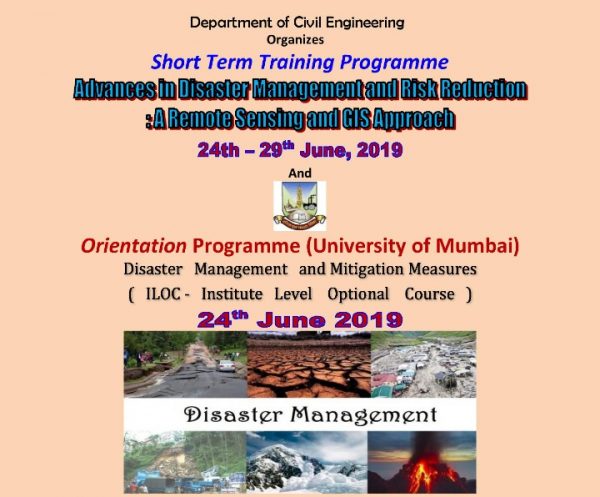
    Mahatma Education Society’s Pillai HOC College of Engineering and Technology, PHCET, Rasayani Department of Civil Engineeering is organising a Short Term Training Progamme (STTP) on “Advances in Disaster Management and Risk Reduction: A Remote Sensing and GIS Approach” from 24th to 29th June, 2019.

    Date
    Department
    24th to 29th June, 2019
    Civil Engineering

    Orientation Programme on
    “Disaster Management and Mitigation Measures” on 24th June, 2019 for all faculty members of University of Mumbai (All Branches). Download Brochure

    As University of Mumbai has revised the syllabus with respect to CBCGS from the Academic Year 2016-17 wherein the Final Year Institute Level Optional Course (ILOC) have introduced in which Disaster Management and Mitigation Measures (DMMM) is one of the ILOC in VII semester for all branches.

    All Registered participants will be offeted 2 Free Course on Disaster Management and RS / GIS from Pillai ISRO Outreach Network Institute and IIRS ISRO will provide these course certificates.

    Who Should Attend

    • Ph.D. research scholars
    • Faculty-Engineering, Polytechnic, Architecture and Management Institutions
    • Technical / Scientific Staff of Central / State Government / Faculty / researchers
    • Delegates from Industries and R & D Organizations
    • Geographers, Geologists & Environmentalist
    • U.G, P.G. Students (Specially Students of Mumbai University who are having this subject in their current Syllabus)

    Registration Details (Mandatory): click here

    Eminent Speakers form ISRO, NDMA, MCGM, BMC, CIDCO and IITs etc and other government organisations will deliver lectures and discuss recent case studies involved in management and mitigation measures on various disasters..

    Buses from CIDCO Circle near Panvel Railway station will start at 8:20 a.m.

    Contact Details:
    Mr. Karthik Nagarajan: 08779605643
    Mr. Raju Narwade: 08108202122

  • International Yoga Day 2019

    International Yoga Day 2019

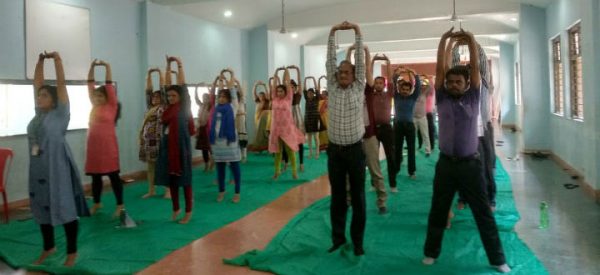
    International Yoga Day (celebrated on 21st June, 2019) Organised by Department of Electronics and Telecommunication Engineering.

    Date
    Place
    23rd July, 2019
    Electronics and Telecommunication Engineering

    Pillai HOC College of Engineering and Technology in association with Internal Quality Assurance Cell (IQAC) and Soroptimists International Bombay, Chembur and Art of Living enthusiastically celebrated 5th International Yoga Day, at PHCET, Rasayani Campus on Thursday, 21st June, 2019. The Program was organized by Department of Electronics and Telecommunication Engineering. The session was taken by the trained Yoga and meditation trainers from Art of living.

    international-yoga-day (1)
    international-yoga-day (2)
    international-yoga-day (3)
    international-yoga-day (4)
    international-yoga-day (5)

    The session started at 2:15 p.m. Around 50 faculty and non-teaching staff took part in this celebration and practiced Yoga and Meditation. Mr. Pradeep Patil, Sectional Engineer in State Government Maharashtra, Mr. Narayan Patil, Electrical Engineer at JNPT and Ms. Sandhya Patil, Teacher in Sri Sanskar Kendra School had been invited as guests of honour and were the trainers. They were welcomed by Dr. Madhumita Chatterjee, Principal PHCET and Ms. Divya Chirayil, Head of Department of Electronics and Telecommunication Engineering. The session was engaged with Yoga, Pranayam and Meditation. All participants performed some simple warm up exercises. Proper scientific instructions were given for all the yoga asanas and everyone performed it as per instruction. Various Asanas like Parvatasan, Vajrasan, Tadasan, Marjarasan etc. were performed and its benefits were told to all the participants. The session ended with guided meditation by Gurudev Sri Sri Ravi Shankar and all participants experienced feeling of happiness, positive vibration andrelaxed. Experience of Meditation was enlighted to all and they also guided to be happy. Importance of meditation, Yoga was guided to all the participants and happiness was experienced by all.

    The session was very relaxing and rejuvenation was experienced by all on the eve of celebration of International Yoga Day.

  • Seminar on “Mind Map”

    Seminar on “Mind Map”

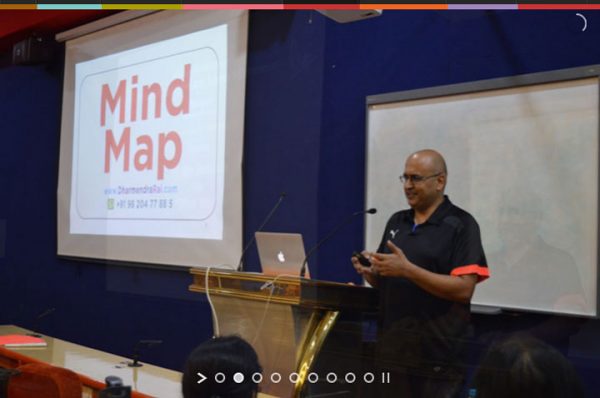
    Internal Quality Assurance Cell (IQAC) of Pillai HOC College of Engineering and Technology and IQAC of PHCASC, Rasayani organised a Seminar on “Mind Map” on 8th May, 2019. The resource person for the same was Mr. Dharmendra Rai, who is considered to be Mumbai’s first mind map trainer. The guest of honour is declared a “Genius” by Tony Buzan – Mind Map Inventor & Nobel Peace Prize Nominee. He has conducted 302 Mind Map Seminars – Probably a world record!

    The Deputy CEO of the campus, Dr. Lata Menon and Principal Dr. Madhumita Chatterjee welcomed the guest. The workshop was organised to introduce the concept of mind map in academics. The speaker put forth the idea of teaching methodology easier in all subjects and techniques to follow to implement the idea successfully. The session began with introduction of 4 pillars of Education as per UNESCO which can be employed in institutions for students. The trainer talked about mind map or brain activity is often enhanced by images, colour, associations, grouping and location. He also generated interest on lateral thinking and relevance of 4Cs, critical thinking, creativity, communication and collaboration.

    seminar-on-mind-map (1)
    seminar-on-mind-map (2)
    seminar-on-mind-map (3)
  • Business Plan Competition 2018-19

    Business Plan Competition 2018-19

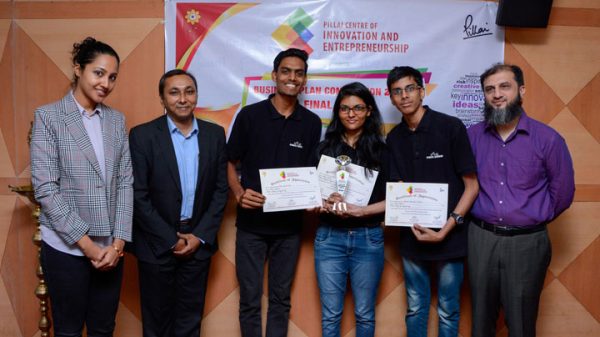
    Five teams competed at the finale of Business Plan Competition 2018-19 held on 5th April, 2019 at the Conclave, Dr. K. M. Vasudevan Pillai Campus, Panvel.

    Team Indian Hybrid from Pillai College of Engineering, Panvel were adjudged the winners of the competition and were awarded prize money of Rs. 1 Lakh. The first runners up were Team Nustaa Chai from Pillai HOC College of Engineering, Rasayani and Second runners up were Team Solution Lifty Pvt. Ltd. from Pillai HOC College of Arts, Science and Commerce, Rasayani. The first runners up and second runners up were awarded prize money of Rs. 20,000 and Rs. 10,000 respectively.


    The finalist teams were

    • Indian Hybrid: Ketan Naresh Jain, Deepesh Narendra Chitale and Harshita Jagannath Pujari from Pillai College of Engineering, Panvel
    • Nustaa Chai: Shah Harshit Naresh and Shirke Shubham Jagdish from Pillai HOC College of Engineering, Rasayani
    • Solution Lifty Pvt. Ltd.: Aayushi Bhagwati Badala and Hrishikesh Ravikanth Patil from Pillai HOC College of Arts, Science and Commerce, Rasayani
    • Garage on Wheels: Sharma Balvir Devendr from Pillai College of Engineering, Panvel & Kunal Arvind Pawar from Pillai HOC College of Engineering, Rasayani
    • Mydaymaid: Srushti Thakkar and Progna Malay Banerjee from Pillai Institute of Management Studies and Research, Panvel
  • Workshop on “Hot Bulk Forging and Extrusion Technologies”

    Workshop on “Hot Bulk Forging and Extrusion Technologies”

    PHCET and PCE successfully conducted Workshop on “Hot Bulk Forging and Extrusion Technologies” for students and faculty members of PHCET and PCE to cover various aspects of forging and its applications.

    Date
    Resource Person
    Coordinator
    Department
    1st April, 2019
    Dr. R. C. Prasad
    Dr. G. V. Patil
    Mechanical Engineering

    Hot bulk forging and extrusion are advanced manufacturing processes used to shape metal components at elevated temperatures. These technologies are employed in the production of high-strength and complex-shaped parts for various industries, including automotive, aerospace, and construction. Here’s a brief overview of each:

    1. Hot Bulk Forging:
      • Process: In hot bulk forging, metal is heated to elevated temperatures, typically above its recrystallization temperature, to enhance its plasticity and reduce deformation resistance. The heated metal is then shaped using compressive forces in a die to achieve the desired final form.
      • Advantages:
        • Improved material flow and formability at elevated temperatures.
        • Enhanced mechanical properties and part strength due to refined grain structure.
        • Complex shapes with close tolerances can be achieved.
    2. Extrusion:
      • Process: Extrusion involves forcing a metal billet or ingot through a shaped die to produce continuous lengths of complex cross-sectional profiles. This process is widely used for the production of tubes, rods, and various other profiles.
      • Advantages:
        • High material utilization as there is minimal waste.
        • Ability to produce components with intricate cross-sections.
        • Improved mechanical properties due to the aligned grain structure along the extrusion direction.
        • Suitable for a variety of materials, including metals and polymers.
    3. Both hot bulk forging and extrusion technologies offer several advantages over cold forming processes, such as increased material ductility, reduced forming forces, and the ability to produce large and intricate components. These processes are crucial in achieving cost-effective and high-quality production of metal components with enhanced mechanical properties.

      Workshop-on-“Hot-Bulk-Forging-and-Extrusion-Technologies” (2)
      Workshop-on-“Hot-Bulk-Forging-and-Extrusion-Technologies” (3)
  • Workshop on “Applications of Mechanical and Automobile Engineering using Matlab Tool”

    Workshop on “Applications of Mechanical and Automobile Engineering using Matlab Tool”

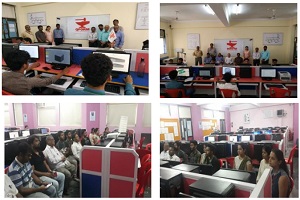
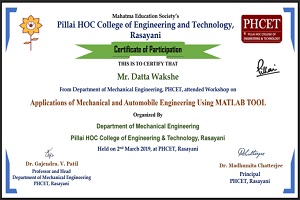
    PHCET successfully conducted Hands on workshop on “Applications of Mechanical and Automobile Engineering using Matlab Tool” for faculty members of PHCET to cover various aspects of Matlab and its applications in Mechanical and Automobile Engineering.

    Date
    Venue
    Coordinator
    Department
    2nd March, 2019
    CAD CAM Lab, PHCET
    Dr. G. V. Patil
    Mechanical Engineering

    Matlab, a powerful numerical computing software, finds diverse applications in the fields of Mechanical and Automobile Engineering. Some of its key applications are as follows.

    Workshop-on-“Applications-of-Mechanical-and-Automobile-Engineering-using-Matlab-Tool” (2)
    Workshop-on-“Applications-of-Mechanical-and-Automobile-Engineering-using-Matlab-Tool” (1)
    1. Modeling and Simulation:
      Engineers use Matlab to model and simulate mechanical systems, such as dynamic structures, thermal systems, and fluid flow. This aids in predicting system behavior, analyzing performance, and optimizing designs.
    2. Control Systems Analysis and Design:
      Matlab is extensively employed for the analysis and design of control systems in both mechanical and automotive applications. Engineers use it to model and simulate control algorithms, analyze system stability, and design controllers for optimal performance.
    3. Finite Element Analysis (FEA):
      FEA is widely used in mechanical engineering for structural analysis. Matlab, with its robust numerical capabilities, is utilized to perform FEA simulations, assessing the structural integrity and behavior of components and systems under various loads.
    4. Automotive System Design:
      Matlab is employed in the design and simulation of automotive systems, including engines, transmissions, and vehicle dynamics. It allows engineers to model complex interactions and optimize parameters for fuel efficiency, performance, and safety.
    5. Signal Processing and Image Processing:
      In both Mechanical and Automobile Engineering, Matlab is utilized for signal processing applications. It is employed in analyzing and processing signals from sensors, such as accelerometers and strain gauges, to extract valuable information about system behavior.
    6. Vehicle Dynamics and Simulation:
      Matlab is used to model and simulate the dynamics of vehicles, considering factors like suspension systems, tire characteristics, and aerodynamics. This aids in understanding and improving the overall performance and handling of vehicles.
    7. Computational Fluid Dynamics (CFD):
      Matlab is applied in CFD simulations to analyze fluid flow patterns around objects, including vehicles. This is crucial for optimizing aerodynamics, improving fuel efficiency, and reducing drag.
    8. Optimization and Design Automation:
      Engineers use Matlab for optimization tasks, helping to find the best design parameters and configurations. This is valuable in achieving optimal performance, minimizing costs, and meeting specific design criteria.

    In summary, Matlab is a versatile tool in Mechanical and Automobile Engineering, providing a platform for modeling, simulation, analysis, and optimization. Its capabilities contribute significantly to the advancement and innovation in these engineering disciplines.

  • Industrial Visit to Centre for Development of Advanced Computing (C-DAC), Pune

    Industrial Visit to Centre for Development of Advanced Computing (C-DAC), Pune

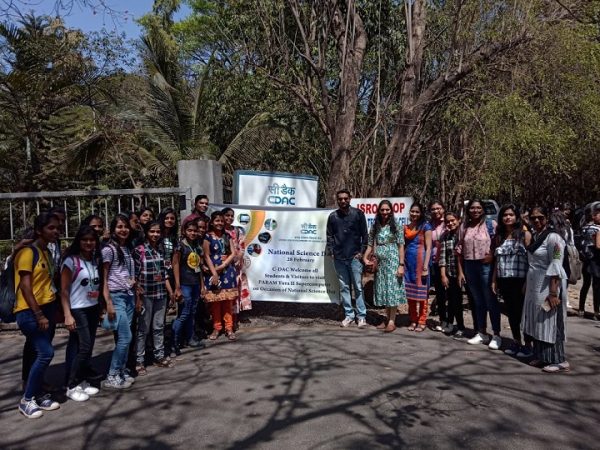
    CDAC: An Industrial Visit was conducted by Department of Information Technology, PHCET to Centre for Development of Advanced Computing (C-DAC), Pune on National Science Day organising an Open Day on evet of National Science Day organised on Thursday, 28th February, 2019. 75 students from the IT Department visited CDAC Labs along with 6 faculty members.

    Date
    Venue
    Department
    28th February, 2019
    Centre for Development of Advanced Computing, Pune University Campus, Ganesh Khind Pune – 411 007, Maharashtra (India)
    Information Technology Engineering

    Company Profile: Centre for Development of Advanced Computing (C-DAC), Pune occupies a special place in the evolution of the organization as a premier hub for cutting edge R&D. Bestowed with the distinction of being the first C-DAC centre to be established in the country, C-DAC, Pune has been at the forefront of the organizations R&D initiatives and spearheading several national programmes of strategic importance. C-DAC, Pune is credited for the first indigenously developed PARAM supercomputer and establishing the nations credentials as an enabler of advanced technologies. While placing India on the select world map of supercomputing nations, C-DAC, Pune has continued to pioneer the open frame architecture to deliver PARAM Yuva, which was also India fastest supercomputer and rated 64 among world’s top supercomputers.

    industrial-visit-to-C-DAC-pune (1)
    industrial-visit-to-C-DAC-pune (2)
    industrial-visit-to-C-DAC-pune (3)
    industrial-visit-to-C-DAC-pune (4)
    industrial-visit-to-C-DAC-pune (5)
    industrial-visit-to-C-DAC-pune (6)
    industrial-visit-to-C-DAC-pune (7)
    industrial-visit-to-C-DAC-pune (8)
    industrial-visit-to-C-DAC-pune (9)

    C-DAC, Pune is also recognized for promoting the concept of multilingual computing in the country to take IT to the grassroots level by defining the standards for the adoption of Indian languages on computers. Since then, the centre has made great strides in this arena through products and technologies that have created a new platform for multilingual users in India as well as abroad.

    The expertise garnered through the years of experience has also led C-DAC, Pune to diversify its activities to other domains of advanced R&D namely geomatics, human-centred design & computing, health informatics and education & training. This in turn has elevated C-DAC, Pune into the role of a mentor and an incubator of innovation, in the greater national interest.

    As part of the mandate to generate manpower to address the growing demand for trained manpower in the advanced areas of Information Technology, C-DAC, Pune established its Advanced Computing Training School (ACTS). Currently the centre offers a variety of course options including for international collaborations.

    Model:

    PARAM Yuva II: It is a High Performance Computing (HPC) Cluster that is latest and fastest in the prestigious PARAM series of Supercomputers built in India. The first sub-cluster of PARAM Yuva II with a peak computing power of 529.4 Tera Flops (TFs) was ranked 69th in the Top500 list released in June’ 2013 at the International Supercomputing Conference held at Leipzig, Germany.

    Housed at C-DAC premises in the Pune University campus, PARAM Yuva II is a High Performance Computing (HPC) hybrid cluster with multiple interconnects, compute co-processor, high performance storage and supporting software’s for parallel computing. In the PARAM series of supercomputers, Yuva II is an upgraded version of PARAM Yuva, is yet another step towards creating a general purpose research oriented computational environment architected to solve bigger problems and provide an opportunity for scientific breakthroughs. The increase in peak compute power from 54 Teraflop/s to more than half a Petaflop/s is achieved without any increase in the electrical power and cooling required for the facility. The Center for Development of Advanced Computing (C-DAC) achieved a significant milestone with PARAM Yuva II being ranked 1st in India, 9th in the Asia Pacific Region and 44th in the world among the most power efficient computer systems with performance of 1,760.20 Mega Flops (MFs) per Watt as per the Green500 list released in November’ 2013 at the Supercomputing Conference held at Denver, Colorado, USA.

    High Performance Computing (HPC) systems consume lot of electrical power and produce heat that necessitates requirement of appropriate cooling facilities to ensure proper operation. To draw focus towards development of energy efficient supercomputers, Green500 list ranks computer systems across the globe according to compute performance obtained per watt, thus providing world ranking based on energy efficiency.

    Computational Biology: Computational biology has undergone a paradigm shift. The world of genomics has undergone a revolution and their effects are becoming increasingly widespread, with the exponential rise in data. Challenges in the modern era of computational biology have shifted focus from data generation to data analysis. Huge amounts of raw data needs to be pre-processed, assayed and integrated with existing expertise through the use of diverse sets of software tools, models and databases.

  • Workshop on “Challenges and Opportunities in Foundry Industries for Engineering Students”

    Workshop on “Challenges and Opportunities in Foundry Industries for Engineering Students”

    PHCET and PCE successfully conducted Workshop on “Challenges and Opportunities in Foundry Industries for Engineering Students” for students of PHCET and PHP to cover various aspects of foundry industries and its applications.

    Date
    Venue
    Resource Person
     
    Coordinators
    Department
    14th February, 2019
    Conclave-1, PHCET
    Mr. Yash Singh, Director Greycast Founders & Chairman, Indian Institute of Foundrymen, Greater Mumbai Chapter
    Dr. R. C. Prasad, Dr. G. V. Patil
    Mechanical Engineering
    Workshop-on-“Challenges-and-Opportunities-in-Foundry-Industries-for-Engineering-Students” (1)
    Workshop-on-“Challenges-and-Opportunities-in-Foundry-Industries-for-Engineering-Students” (2)
    Workshop-on-“Challenges-and-Opportunities-in-Foundry-Industries-for-Engineering-Students” (3)
    Workshop-on-“Challenges-and-Opportunities-in-Foundry-Industries-for-Engineering-Students” (4)

    Foundry industries are integral to the production of metal castings, which are crucial components in a wide range of applications across industries such as automotive, aerospace, construction, and machinery manufacturing. The primary objective of a foundry is to melt metal, pour it into molds, and then solidify it to create intricate and customized shapes.

    Foundry industries are vital for shaping metals into diverse and essential components, supporting various industries and contributing significantly to economic development. Ongoing advancements in technology and sustainability practices are crucial for the continued growth and success of foundry operations.

  • Workshop on “Non Destructive Testing”

    Workshop on “Non Destructive Testing”

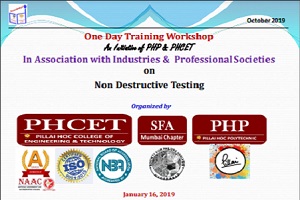
    PHCET and PCE successfully conducted workshop on “Non Destructive Testing” for students and faculties of PHCET and PHP to cover various aspects of Non Destructive Techniques and its applications.

    Date
    Venue
    Resource Person
     
    Coordinators
    Department
    16th January, 2019
    SOM Lab, PHCET
    Mr. Tony Lau and Mr. Edward Ma M/s Zhongke Innovation Technology Co. Ltd, Hubei, China
    Dr. R. C. Prasad, Dr. G. V. Patil
    Mechanical Engineering

    Non-Destructive Testing (NDT) is a set of techniques used to evaluate the properties of materials, components, or systems without causing damage to the tested object. This type of testing is crucial in various industries to ensure the safety, reliability, and integrity of structures and components. NDT plays a vital role in quality control, maintenance, and failure analysis.

    Key points about Non-Destructive Testing:

    1. Purpose: NDT is employed to detect and assess defects, irregularities, or discontinuities in materials or structures without altering their physical or chemical properties. It helps in identifying potential issues before they lead to catastrophic failures.
    2. Techniques: There are various NDT techniques, each suitable for specific applications. Common methods include ultrasonic testing, radiographic testing, magnetic particle testing, liquid penetrant testing, eddy current testing, and visual inspection.
    3. Ultrasonic Testing (UT): This method uses high-frequency sound waves to detect internal flaws or defects. It is widely used for inspecting welds, castings, and forgings.
    4. Radiographic Testing (RT): RT involves the use of X-rays or gamma rays to create images of the internal structure of an object. It is effective in identifying defects such as cracks, voids, or inclusions.
    5. Magnetic Particle Testing (MT): MT is used to detect surface and near-surface flaws in ferromagnetic materials by applying a magnetic field and observing the response of iron particles.
    6. Liquid Penetrant Testing (PT): PT involves applying a liquid with high surface tension to the surface of a material. The liquid penetrates surface-breaking defects, and after excess liquid is removed, a developer highlights the defects.
    7. Eddy Current Testing (ECT): ECT uses electromagnetic induction to detect surface and near-surface flaws, as well as measure material thickness and conductivity.
    8. Visual Inspection: The simplest form of NDT involves a direct visual examination of the object. This can include the use of borescopes, endoscopes, or other optical devices.
    9. Applications: NDT is widely used in industries such as aerospace, automotive, oil and gas, power generation, construction, and manufacturing. It ensures the quality of products, structural integrity, and the safety of critical components.
    10. Advantages:
      • Cost-effective compared to destructive testing methods.
      • Allows for the inspection of finished products without compromising their usability.
      • Helps in preventive maintenance, reducing the risk of unexpected failures.

    Non-Destructive Testing is a crucial set of techniques that provide valuable insights into the quality and integrity of materials and structures, contributing to the overall safety and reliability of industrial processes and products.

  • Workshop on “Steels For Smart Cities”

    Workshop on “Steels For Smart Cities”

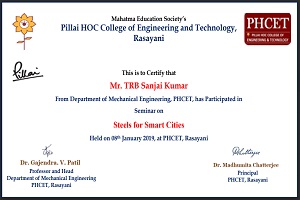
    PHCET and PCE successfully conducted Workshop on “Steels For Smart Cities” for students and faculty members of PHCET and PCE to cover various aspects and applications of steels used in smart cities.

    Date
    Resource Person
    Coordinator


    Department
    8th January, 2019
    Dr. S. Ramani (Founding Director of the National Centre for Software Technology)
    Dr. Rakesh Kumar (Director CSIR-NEERI, Nagpur)
    Dr. Dhiren Patel (Director, VJTI, Mumbai)
    Dr. Priam Pillai (COO, Mahatma Education Society)
    Dr. R. C. Prasad (Vice Chairman Mumbai SFA Chapter)
    Dr. G. V. Patil
    Mechanical Engineering
    Workshop-on-“Steels-For-Smart-Cities” (2)
    Workshop-on-“Steels-For-Smart-Cities” (3)

    Steel plays a crucial role in the development of smart cities due to its versatile properties and applications.

    Steel in Smart Cities:

    Infrastructure Backbone: Steel serves as the backbone for the infrastructure of smart cities. It is widely used in the construction of buildings, bridges, and other critical structures due to its strength, durability, and ability to withstand environmental conditions.

    High-Rise Construction: Smart cities often feature high-rise buildings with advanced technological integration. Steel’s high strength-to-weight ratio makes it an ideal choice for constructing tall structures, providing stability and flexibility in design.

    Smart Grids and Communication Towers: The implementation of smart grids, communication towers, and other connectivity infrastructure relies on steel. Its durability and load-bearing capacity support the installation of antennas, sensors, and communication equipment essential for smart city networks.

    Transportation Systems: Steel is extensively used in the construction of transportation systems, including bridges, tunnels, and railway tracks. Its resilience contributes to the safety and longevity of these structures, ensuring efficient and reliable urban mobility.

    Smart Materials and Coatings: Innovative steel materials with enhanced properties, such as corrosion resistance and self-healing capabilities, contribute to the development of smart infrastructure. These materials can reduce maintenance costs and increase the lifespan of structures.

    Environmental Sustainability: Steel’s recyclability makes it an environmentally sustainable choice for smart cities aiming to minimize their carbon footprint. The use of recycled steel in construction aligns with the sustainability goals of modern urban development.

    In summary, steel is a foundational material for smart cities, providing the strength and adaptability needed for modern infrastructure. Its integration supports the development of resilient, technologically advanced, and environmentally sustainable urban environments.