

Master of Technology in Electronics and Telecommunication Engineering
| Affiliated to | Duration | Academic Year | Sanctioned Intake | Exam Structure |
|---|---|---|---|---|
| Mumbai University | 2 years, Full Time | 2 semesters each | 12 | Theory, Practical, Oral, Term Work |
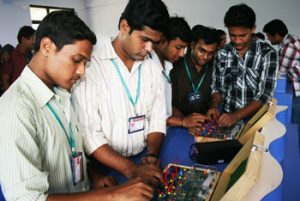
Electronics and Telecommunication Engineering is a field that involves complex electronic apparatus, circuits and equipments that help in executing speedy and efficient telecommunication systems. These engineers design, fabricate, maintain, supervise and manufacture electronic equipments used in entertainment industry, computer industry, communication and defense. Ever increasing pace of development in electronics, audio and video communications systems and the automation in industry have made an electronic engineer a catalyst for the change of the modern society. Electronics gadgets and communication systems of present age have tremendously improved the quality of life. With the tempo of events throughout the world, it has become essential to have more efficient communication network with the latest electronic devices and circuits. Besides giving a thorough grounding in basic sciences and engineering subjects, the curriculum in Electronics and Telecommunication Engineering lays greater emphasis on deep understanding of fundamental principles and state of the art knowledge about electronic devices and circuits, computer architecture and microprocessors, VLSI and embedded systems, electromagnetic field theory, analog and digital communication, digital signal processing, microwave and broadband communications.
Vision
To develop competent Electronics and Telecommunication engineers through an effective teaching learning process and quality research to make them world class professionals who strive continuously in pursuit of excellence with commitments for the society and respect to environment.
Mission
- To focus on innovative and interactive teaching learning process and shaping their academic foundation in Electronics and Telecommunication Engineering.
- To inculcate in our student global competencies so that they can excel in quality education and research.
- To develop students for spirit of professionalism and ethical attitude with commitment towards society.
POs, PEOs and PSOs
Program Outcomes (POs)
Engineering Graduates will be able to:
- PO1: Engineering Knowledge: Apply knowledge of mathematics, natural science, computing, engineering fundamentals and an engineering specialization to develop to the solution of complex engineering problems.
- PO2: Problem Analysis: Identify, formulate, review research literature and analyze complex engineering problems reaching substantiated conclusions with consideration for sustainable development.
- PO3: Design/Development of Solutions: Design creative solutions for complex engineering problems and design/develop systems/components/processes to meet identified needs with consideration for the public health and safety, whole-life cost, net zero carbon, culture, society and environment as required.
- PO4: Conduct Investigations of Complex Problems: Conduct investigations of complex engineering problems using research-based knowledge including design of experiments, modelling, analysis & interpretation of data to provide valid conclusions.
- PO5: Engineering Tool Usage: Create, select and apply appropriate techniques, resources and modern engineering & IT tools, including prediction and modelling recognizing their limitations to solve complex engineering problems.
- PO6: The Engineer and The World: Analyze and evaluate societal and environmental aspects while solving complex engineering problems for its impact on sustainability with reference to economy, health, safety, legal framework, culture and environment.
- PO7: Ethics: Apply ethical principles and commit to professional ethics, human values, diversity and inclusion; adhere to national & international laws.
- PO8: Individual and Collaborative Team work: Function effectively as an individual, and as a member or leader in diverse/multi-disciplinary teams.
- PO9: Communication: Communicate effectively and inclusively within the engineering community and society at large, such as being able to comprehend and write effective reports and design documentation, make effective presentations considering cultural, language, and learning differences
- PO10: Project Management and Finance: Apply knowledge and understanding of engineering management principles and economic decision-making and apply these to one’s own work, as a member and leader in a team, and to manage projects and in multidisciplinary environments.
- PO11: Life-Long Learning: Recognize the need for, and have the preparation and ability for i) independent and life-long learning ii) adaptability to new and emerging technologies and iii) critical thinking in the broadest context of technological change.
Program Educational Objectives (PEOs)
- To provide theoretical knowledge and practical training in Electronics and Telecommunication Engineering subjects for deploying feasible systems.
- To develop the next generation Telecommunication technology through research and development.
- To educate the students to analyze the technical problems of the society and find the product based solution in responsive and innovative manner.
- To inculcate the habit of lifelong learning of career development through successful completion of advance professional courses, industrial training etc.
- To create awareness among the students towards the ethical, social and environmental issues in the professional career.
Program Specific Outcomes (PSOs)
A Graduate in Electronics and Telecommunication Engineering shall be able to
- Analyse complex engineering problems in Electronics and Telecommunication and identify optimal solutions
- Design systems and processes to meet the needs in Electronics and Telecommunication Engineering with a realistic understanding of the constraints of resources
- Understand and resolve the challenges in multidisciplinary projects and contribute productively as a team player
- Choose the world of work or pursue advanced studies in the chosen field of the individual
Master of Engineering in Electronics and Telecommunication Engineering
| Affiliated to | Duration | Academic Year | Sanctioned Intake | Exam Structure |
|---|---|---|---|---|
| Mumbai University | 2 years, Full Time | 2 semesters each | 12 | Theory, Practical, Oral, Term Work |