Program Overview

Bachelor of Technology in Mechanical Engineering

Affiliated to Duration Academic Year Sanctioned Intake Exam Structure Theory Exam
Mumbai University
4 years, Full Time
2 semesters each
90Theory, Practical, Oral, Term Work
Conducted by University of Mumbai

mechanical

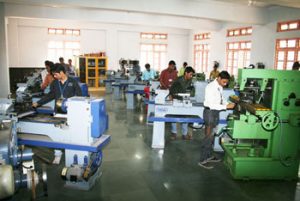
Mechanical Engineering is the branch of engineering that is generally concerned with understanding forces and motion and their application to solving problems of interest to society. The field includes aspects of thermodynamics, fluid and solid mechanics, mechanisms, materials and energy conversion and transfer and involves the application of physics, mathematics, chemistry and increasingly, biology and computer science. Importantly, the field also emphasizes the process of formulation, design, optimization, manufacture and control of new systems and devices.

Message from Head of Department, Mechanical Engineering

The above video depicts the working of a CNC (Computer Numerical Control) machine. The Department of Mechanical Engineering is committed to support the students encouraging them with every facility possible. This rigor of the department towards new and upcoming technologies has led to the adaptation and incorporation of these technologies as part of the curriculum which is not even mandated by the University. Various such equipment are procured by the Department and are available for Under Graduate and Post Graduate students at their disposal.

Vision

To be a leading department for the Mechanical Engineering program fostering global competence for societal impact

Mission

  • To provide students with a comprehensive foundation in mechanical engineering and advanced technology skills.
  • To develop independent professionals who lead teams and drive innovation in mechanical engineering, solving complex challenges with sustainable solutions.
  • To promote a culture of research and entrepreneurship that addresses global challenges in mechanical engineering.

POs, PEOs and PSOs

Program Outcomes (POs)
Engineering Graduates will be able to:

  • PO1: Engineering Knowledge: Apply knowledge of mathematics, natural science, computing, engineering fundamentals and an engineering specialization to develop to the solution of complex engineering problems.
  • PO2: Problem Analysis: Identify, formulate, review research literature and analyze complex engineering problems reaching substantiated conclusions with consideration for sustainable development.
  • PO3: Design/Development of Solutions: Design creative solutions for complex engineering problems and design/develop systems/components/processes to meet identified needs with consideration for the public health and safety, whole-life cost, net zero carbon, culture, society and environment as required.
  • PO4: Conduct Investigations of Complex Problems: Conduct investigations of complex engineering problems using research-based knowledge including design of experiments, modelling, analysis & interpretation of data to provide valid conclusions.
  • PO5: Engineering Tool Usage: Create, select and apply appropriate techniques, resources and modern engineering & IT tools, including prediction and modelling recognizing their limitations to solve complex engineering problems.
  • PO6: The Engineer and The World: Analyze and evaluate societal and environmental aspects while solving complex engineering problems for its impact on sustainability with reference to economy, health, safety, legal framework, culture and environment.
  • PO7: Ethics: Apply ethical principles and commit to professional ethics, human values, diversity and inclusion; adhere to national & international laws.
  • PO8: Individual and Collaborative Team work: Function effectively as an individual, and as a member or leader in diverse/multi-disciplinary teams.
  • PO9: Communication: Communicate effectively and inclusively within the engineering community and society at large, such as being able to comprehend and write effective reports and design documentation, make effective presentations considering cultural, language, and learning differences
  • PO10: Project Management and Finance: Apply knowledge and understanding of engineering management principles and economic decision-making and apply these to one’s own work, as a member and leader in a team, and to manage projects and in multidisciplinary environments.
  • PO11: Life-Long Learning: Recognize the need for, and have the preparation and ability for i) independent and life-long learning ii) adaptability to new and emerging technologies and iii) critical thinking in the broadest context of technological change.

Program Educational Objectives (PEOs)

  1. To prepare students for advanced technologies available in the fields of finite element analysis, robotics, materials, manufacturing, automobile and thermal engineering.
  2. To educate students in design and development of mechanical products and systems that meet specified requirements by correlating theoretical and practical knowledge gained through various modelling applications and machines.
  3. To train students in various interdisciplinary subjects including management and communication to enhance interpersonal and leadership skillswhich will ultimately improve employability.
  4. To provide opportunity for students to develop real time projects by participating in professional bodies like SAE, e-Yantra, MESA.
  5. To motivate students for lifelong learning and pursuing their achievements, while retaining high ethical values through project and business management.

Program Specific Outcomes (PSOs)

The program aims to develop essential skills and competencies in Mechanical Engineering graduates to:

  1. Analyze and optimize mechanical systems using theoretical knowledge, simulations, and experimental studies
  2. Solve complex problems in mechanical engineering domains, including design, thermal systems, manufacturing, and interdisciplinary areas.
  3. Design and develop renewable energy solutions that apply mechanical engineering principles to promote sustainability and societal impact.
  4. Apply technical, managerial, and entrepreneurial skills to lead projects in product design, development, and deployment while working effectively in interdisciplinary teams.

Bachelor of Engineering in Mechanical Engineering

Affiliated to Duration Academic Year Sanctioned Intake Exam Structure Theory Exam
Mumbai University
4 years, Full Time
2 semesters each
90Theory, Practical, Oral, Term Work
Conducted by University of Mumbai

Course Outcomes