Program Overview

Bachelor of Technology in Electronics and Computer Science Engineering

Affiliated to Duration Academic Year Sanctioned Intake Exam Structure Theory Exam
Mumbai University
4 years, Full Time
2 semesters each
60Theory, Practical, Oral, Term Work
Conducted by University of Mumbai

With the mission of learning new and advanced upcoming technologies department of Electronics and Computer science was established in the years 2021-22. The Electronics & Computer Science (ECS) program integrates two core branches of engineering; Electronics Engineering and Computer Science.

The ECS graduates get an opportunity to learn, how to build smart systems that involve sensors, processors, actuators, communication networks, IoT, Data Science, Data Analytics, Artificial intelligence, Machine Learning etc. The curriculum of ECS has been designed with the objective that it caters to the industry requirement as well as the latest technologies.

Advanced courses like Artificial Intelligence and Machine Learning, Data Sciences, Computer Networks, IoT, Mobile Communication, VLSI, Embedded System and RTOS, Industrial Automation etc. have been added to cater to Industry 4.0 technologies. A practical-oriented approach is being followed to make students proficient in the competitive industry environment as well as prepare them for higher education.

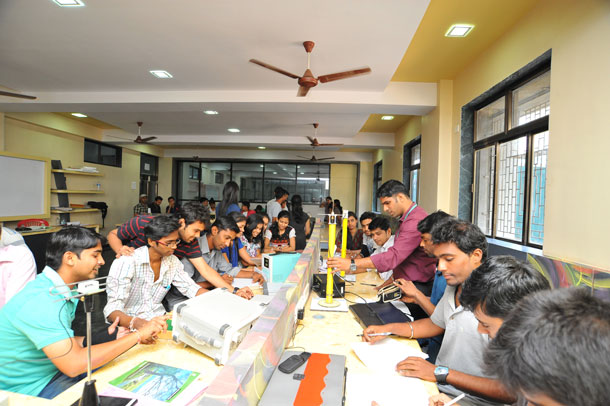
Electronics-Engg-Students

Vision

To develop professionally competent Electronics and Computer Science engineers through an effective teaching learning process and quality research and make them top class professionals with a commitment to society and respect for the environment.

Mission

  • To focus on the innovative and interactive pedagogy and develop students’ academic foundation in Electronics and Computer Science
  • To inculcate in students’ global competencies to critically apply knowledge and skills to solve real world technical issues
  • To develop students for the spirit of professionalism and ethical attitude with commitment towards society

POs, PEOs and PSOs

Program Outcomes (POs)
Engineering Graduates will be able to:

  • PO1: Engineering Knowledge: Apply knowledge of mathematics, natural science, computing, engineering fundamentals and an engineering specialization to develop to the solution of complex engineering problems.
  • PO2: Problem Analysis: Identify, formulate, review research literature and analyze complex engineering problems reaching substantiated conclusions with consideration for sustainable development.
  • PO3: Design/Development of Solutions: Design creative solutions for complex engineering problems and design/develop systems/components/processes to meet identified needs with consideration for the public health and safety, whole-life cost, net zero carbon, culture, society and environment as required.
  • PO4: Conduct Investigations of Complex Problems: Conduct investigations of complex engineering problems using research-based knowledge including design of experiments, modelling, analysis & interpretation of data to provide valid conclusions.
  • PO5: Engineering Tool Usage: Create, select and apply appropriate techniques, resources and modern engineering & IT tools, including prediction and modelling recognizing their limitations to solve complex engineering problems.
  • PO6: The Engineer and The World: Analyze and evaluate societal and environmental aspects while solving complex engineering problems for its impact on sustainability with reference to economy, health, safety, legal framework, culture and environment.
  • PO7: Ethics: Apply ethical principles and commit to professional ethics, human values, diversity and inclusion; adhere to national & international laws.
  • PO8: Individual and Collaborative Team work: Function effectively as an individual, and as a member or leader in diverse/multi-disciplinary teams.
  • PO9: Communication: Communicate effectively and inclusively within the engineering community and society at large, such as being able to comprehend and write effective reports and design documentation, make effective presentations considering cultural, language, and learning differences
  • PO10: Project Management and Finance: Apply knowledge and understanding of engineering management principles and economic decision-making and apply these to one’s own work, as a member and leader in a team, and to manage projects and in multidisciplinary environments.
  • PO11: Life-Long Learning: Recognize the need for, and have the preparation and ability for i) independent and life-long learning ii) adaptability to new and emerging technologies and iii) critical thinking in the broadest context of technological change.

Program Educational Objectives (PEOs)

  1. To provide fundamental knowledge and practical training in Electronics and Computer Science subjects for deploying feasible systems.
  2. To create engineering professionals who can address real-world issues in Electronics Engineering, Computer Science, and allied streams through research and development.
  3. To educate students to analyze technical problems of society and find product-based solutions in a responsive and innovative manner.
  4. To inculcate the habit of lifelong learning of career development through successful completion of advanced professional courses, industrial training, etc.
  5. To create awareness among the students about the ethical, social and environmental issues in their professional career.

Program Specific Outcomes (PSOs)

  1. Gain knowledge and skills to design Electronics circuits and model software-based systems for cutting-edge technologies.
  2. Design and develop algorithms and prototypes to address various issues in the areas like Artificial Intelligence & Machine learning, Big Data, IoT, Information Security, Automation, Embedded Systems, Robotics etc.
  3. Apply modern Electronics and Computer engineering techniques and tools to find solutions for real-life, and multidisciplinary problems.

Bachelor of Engineering in Electronics and Computer Science Engineering

Affiliated to Duration Academic Year Sanctioned Intake Exam Structure Theory Exam
Mumbai University
4 years, Full Time
2 semesters each
60Theory, Practical, Oral, Term Work
Conducted by University of Mumbai

Course Outcomes

View Course Outcomes